State of the Fossil-Free Internet 2026
The Dirty Data Centre Edition
April, 2026 — In this first annual briefing by the Green Web Foundation, we examine the biggest obstacles to a fossil-free internet. This year’s focus: the rise of too many dirty data centres controlled by unaccountable companies. If you work in tech or on climate, this report will help you navigate this vital topic and highlights meaningful pathways to a just and sustainable internet.
Sign up for our free public briefing event online on Wednesday, May 27, 2026.
950,718 unique websites were checked using Green Web Checks in a 24-hour period in December 2025. The dots on the globe represent web host locations. Green means checked websites show evidence of green energy use. Unverified means no evidence was found. Source: Green Web Foundation, 2026
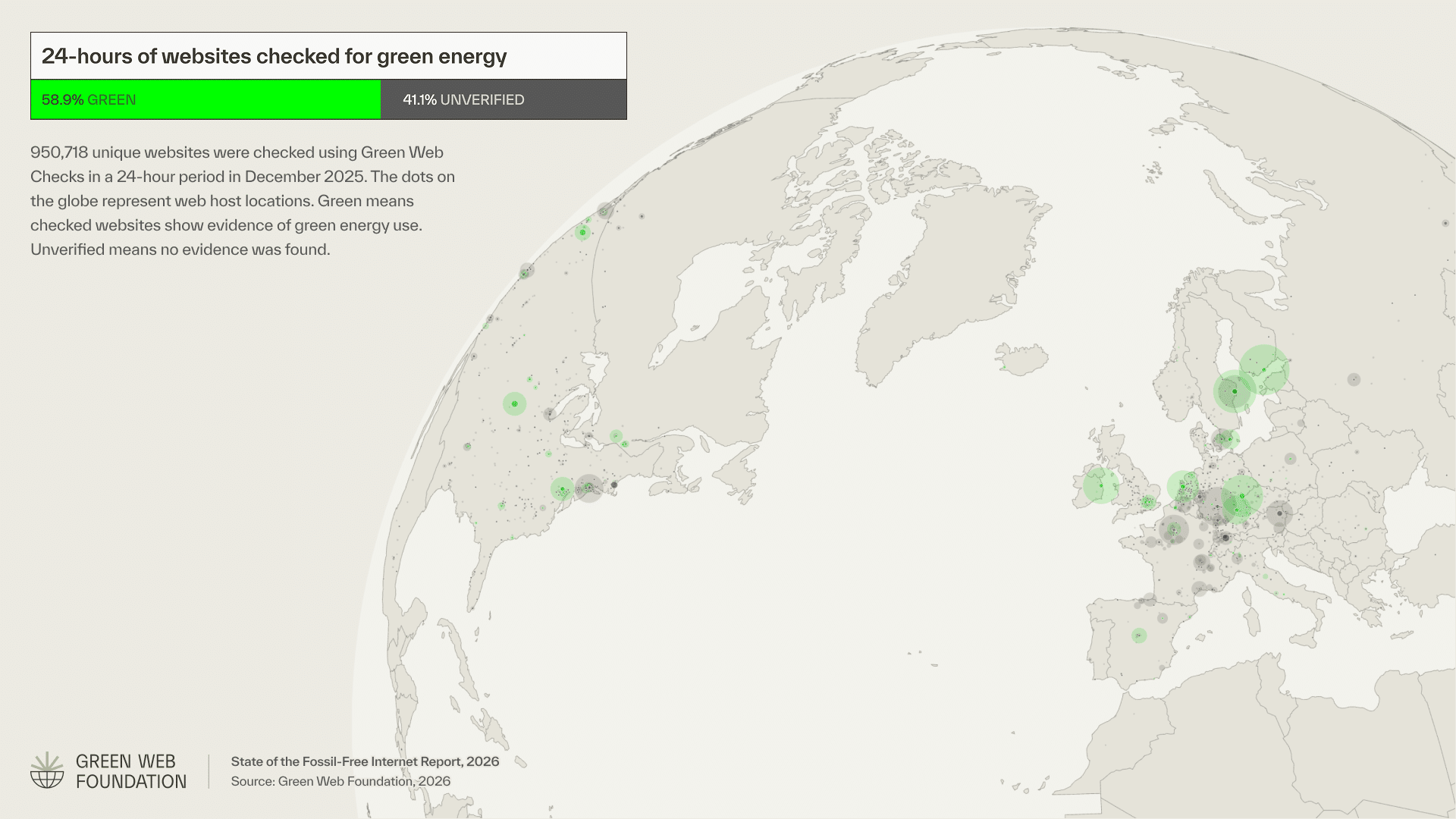
People care how the internet is powered. Every day, 7-15 million Green Web Checks are run to verify whether websites run on green energy. The gases released by fossil fuels used to generate electricity—including carbon dioxide (CO2)—are a leading driver of climate change and harms to human health, which is why many businesses choose to use greener web hosts.
Green Web Foundation works towards a fossil-free internet by 2030—and we’re not alone. A broad spectrum of technologists, businesses, community activists, and governments collaborate on energy and climate goals for the internet. Progress used to be within reach with Google, Microsoft, and Amazon each announcing bold commitments and advances towards matching their energy consumption with 100% clean energy by 2030. Now, the companies that dominate the internet’s infrastructure are polluting the planet more than ever.
This first State of the Fossil-Free Internet is an introductory status update on the 2030 goal. We describe how a massive expansion of fossil-fuelled data centres is putting it at risk, and why it’s so urgent to hold internet and artificial intelligence (AI) companies accountable for their harms. Finally, we share promising pathways—especially for technologists—to spark change.
Data centres and their runaway energy demands
Perhaps somewhere near you, there’s already a massive data centre? Depending on where you live, there soon could be. With the rise of generative AI, the number and scale of data centres is rapidly growing. New data centres worth an estimated $3.2 trillion are planned worldwide.
Ideally, data centres would use fossil-free energy—like solar, wind, and hydropower—to power their facilities. Regrettably, they often rely on fossil fuels—like coal, diesel, oil, and natural gas—instead. Most often, this is determined by what’s available via the local energy grid, but for many it’s also a matter of choice for what new energy infrastructure to build at their sites.
More than half of the anticipated growth in energy demand in the US is coming from data centres. In Europe, too, where data centres currently use an estimated 2% of total electricity, anticipated growth could mean a rise to 5% by 2030.
In India, data centre expansions appear to be derailing clean energy commitments, and similar concerns are rising in Malaysia, Mexico, and many other countries, too.
How many data centres are there? This depends on what gets counted as a data centre. There is no comprehensive global definition based on size, energy, or other attributes. Many, many thousands operate privately, on a small scale, or for secret government and military uses.
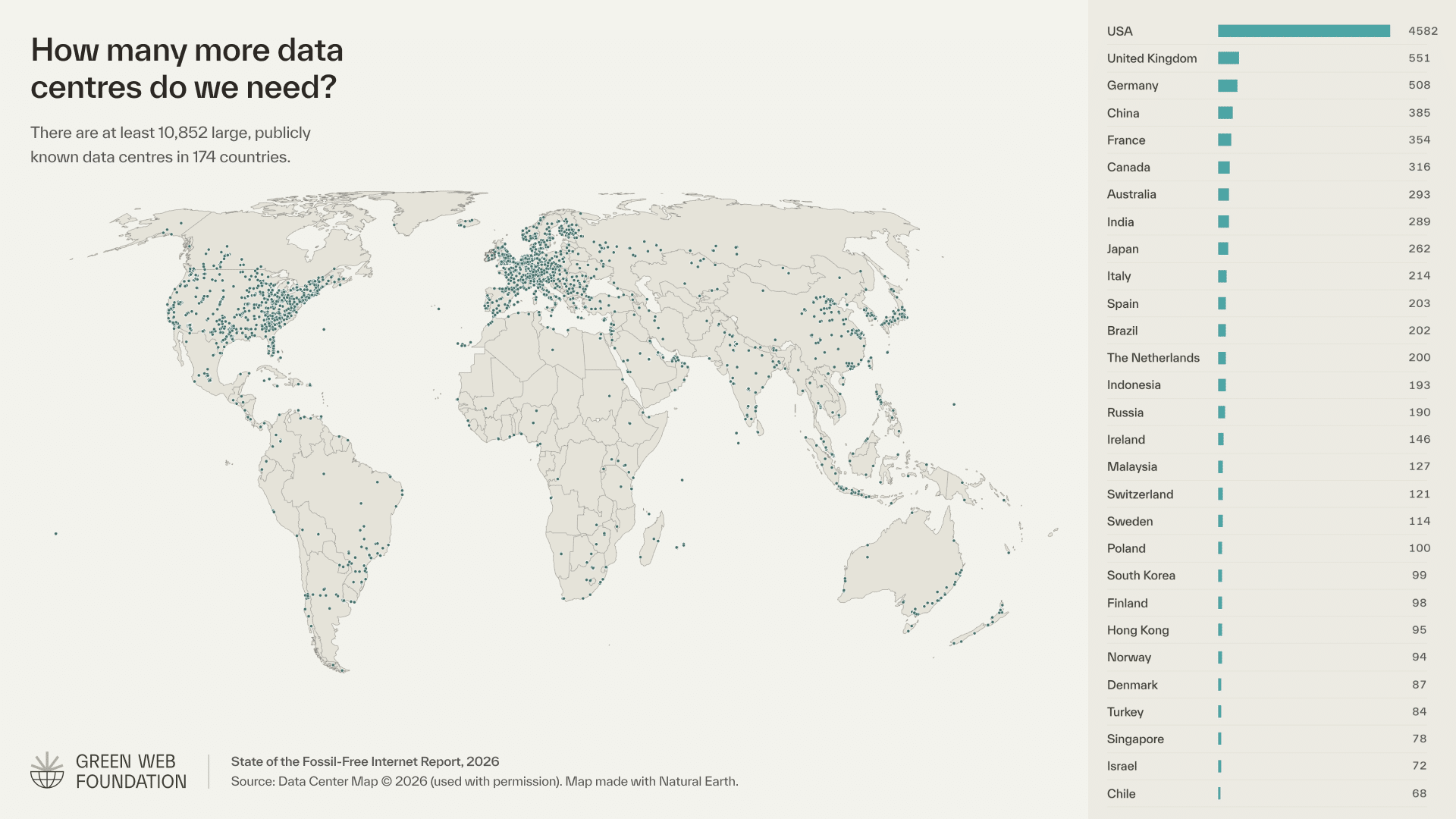
Data Center Map tracks at least 10,852 large, publicly known data centres in 174 countries. In comparison to this number, the expected growth is immense. At least 7,250 new data centre projects are planned. Two-thirds are in North America, followed by Europe and then Latin America.
How many more data centres do we need?
There are at least 10,852 large, publicly known data centres in 174 countries. Source: Data Center Map © 2026 (used with permission). Map made with Natural Earth.
Data centre size is a real game changer. The current wave of generative AI products, like ChatGPT and Claude, use much more computing power and therefore electricity than other software. So, the companies that dominate the internet—and are competing to dominate AI—are investing in much bigger and more energy hungry data centres.
The biggest are called hyperscale data centres and there are at least 1,297 of them worldwide. Their sites (often called campuses) can be as big as dozens of football fields. They can require as much electricity and water as entire towns or cities. In addition, they are driving hardware supply shortages of RAM, disk storage, CPUs and chips across the tech sector, for which mining, manufacturing, and waste disposal also cause environmental harm.
Over the last seven years, the number of hyperscale data centres has tripled. In the next three years, their total global operational capacity could double yet again. Just three companies—Amazon, Microsoft, and Google—control around 58% of today’s global hyperscale capacity. Other major operators are Meta, Alibaba, Tencent, Oracle, Apple, and ByteDance.
The companies behind the popular AI chatbots, ChatGPT (OpenAI), Claude (Anthropic), and Grok (XAI) all use the data centres of the biggest operators. However, they are also each investing billions in the construction of their own hyperscale data centres—again, involving partnerships on financing and hardware with the biggest tech companies.
In their fervour to cash in on AI, data centre operators put a massive strain on local electricity grids. When utility companies cannot meet demand, data centre operators often build their own fossil-fuelled generators and power plants. In the US, the government even compels them to build power plants. In Ireland also, where data centres used 22% of available electricity in 2024, new rules require operators to be able to supply their own on-site electricity during times of grid stress (as a condition of connecting to the grid). It effectively encourages use of fossil gas when renewable energy requirements are weak. In Ireland, the alternative is to go entirely off-grid with fossil-powered data centres, with the first example going live earlier this year.
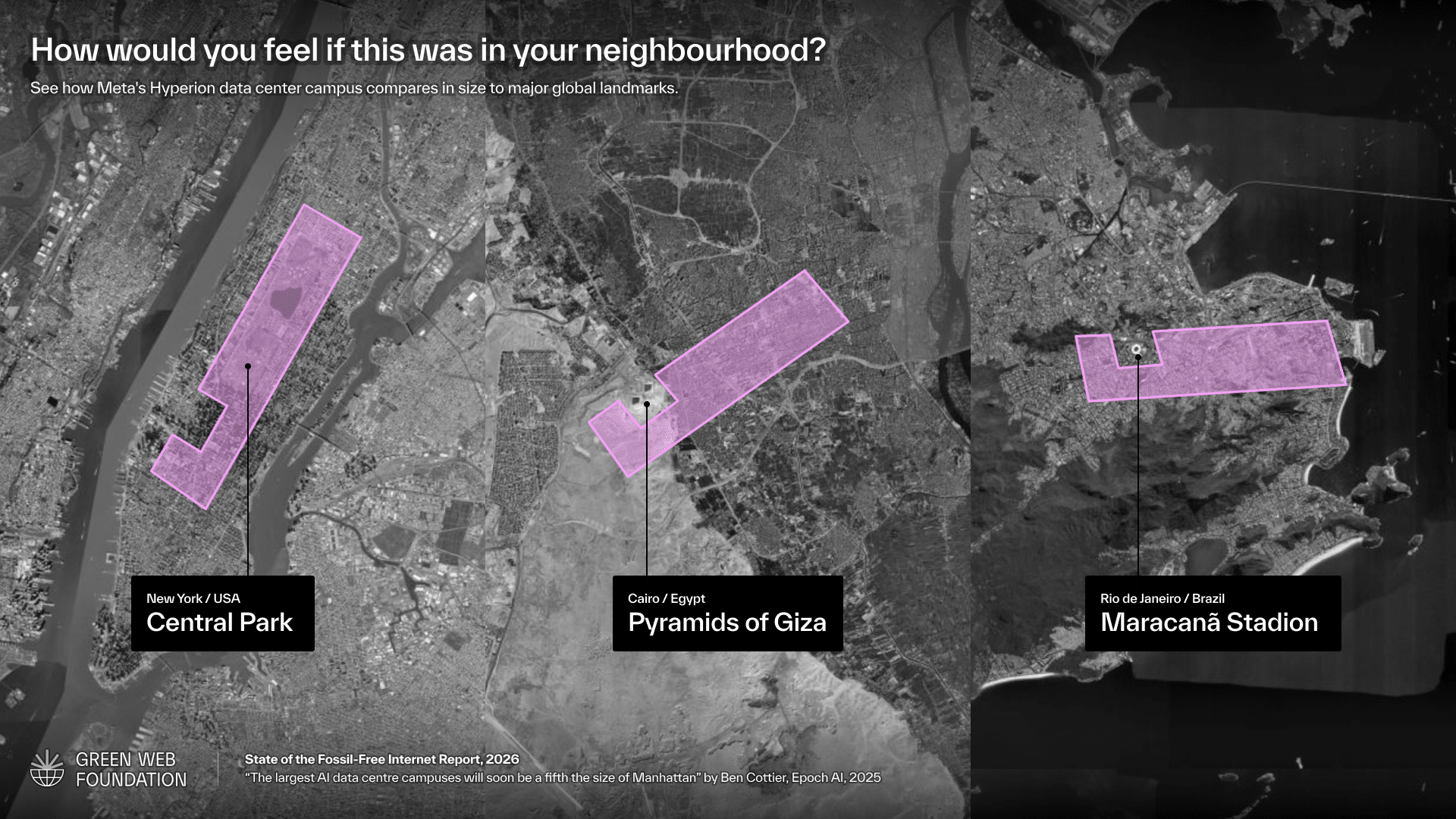
Soon, the world’s largest data centre will be Meta’s Hyperion in Holly Ridge, Louisiana. Still under construction at a cost of over $10 billion, it will be supported by three new gas plants and could consume close to as much power as Los Angeles in California annually.
Hyperion’s 11km² campus is about a fifth of the size of Manhattan in New York.
People living and working near data centres are deeply impacted in many ways.
Gas turbines and diesel generators release toxic emissions that cause higher rates of asthma, heart disease, and cancer. In various cases, tech companies have flouted environmental regulations and concerns while lobbying for governments to fast-track permits and bypass essential protections. In addition, there are countless examples of water drying up in drought affected regions, rising electric bills, and promised jobs that don’t materialise.
All this happens in a cloak of secrecy enforced by data centre operators, with limited public transparency over local government deals and subsidies.
This is a global issue playing out in local communities everywhere. But it’s especially visible in the US because of the sheer amount of data centres and the current government’s support for the fossil fuel industry. Last year, the US tripled its gas power capacity with data centres cited as a leading cause. The carbon intensity of data centres (a proxy for thinking about electricity’s dirtiness) was 48% higher than the national average. It is no coincidence that US greenhouse gas emissions rose by 2.4% in 2025 for the first time in two years.
In Europe, too, plans to ramp up data centre capacity means more gas plants are built to provide power, with the risk that phasing out fossil fuels slows significantly.
Regardless of the origin of emissions, everybody suffers from the harms they cause. The people most impacted by global climate change live in the Global South—meaning data centre operators are inflicting harm far beyond their immediate footprint. Locally too, whenever data centres are placed in regions with less green energy available, or where temperatures are higher and call for more cooling systems, the environmental injustices multiply.
Even before fossil fuels are burned, the process of extracting them from the earth is one of the most unjust and harmful practices on the planet. Once extracted, they remain central to geopolitical conflicts and wars because so many nations rely on imported fuels.
The internet needs data centres—this is understandable. But the fact that such an unprecedented level of destruction is taking place for companies to speculate on AI is wrong. In Europe, people polled say they don’t want more data centres if they are powered by fossil fuels. In the US, the more people learn about data centres, the more negatively they perceive them.
Tech companies are eating the planet
So why are fossil fuels so prevalent across the internet’s infrastructure? One reason is that the tech industry is aligned with the fossil fuel industry. Both extract huge profits from public resources and are among the most highly valued companies in the world.
Oil and gas companies are only glad to supply electricity for the inflated energy demands of data centres, while tech companies benefit from lucrative contracts to automate and accelerate oil extraction with AI. It’s a win-win relationship.
However, the internet does not need fossil fuels to function. There are notable examples that show this is possible even on a large scale. The entire infrastructure could run on green energy (and most likely at comparable costs) since renewables are increasingly affordable and available. Already around 41% of the world’s total electricity use comes from renewable energy.
Google, Amazon and Microsoft control two thirds of the internet’s cloud services. Because of the concentration of power among the biggest tech companies, the actions of just a few companies could theoretically make a huge difference to reducing the global emissions of the internet. Unfortunately, when they do the opposite, it also has a huge impact.
Tech companies boast about their clean energy investments. However, they spend massively on fossil fuels too. Their announcements present a greener image to the public and investors, while masking their continued reliance on fossil fuels. Since the AI boom, fossil fuel use has far outpaced the rate at which these companies can procure renewable energy. Even when they buy more renewables, it doesn’t come close to displacing their use of fossil fuels.
Worse, by purchasing a disproportionate share of renewable energy, tech companies can end up driving up prices for everyone, leaving other sectors unable to transition away from fossil fuels. The rise in energy demand for data centres is just problematic no matter the source of energy. Massive renewable energy projects can have social and environmental costs too, for instance, in the context of lithium mining or displacement of communities.
In recent years, Google, Amazon and Microsoft have all announced targets for lowering their carbon emissions. Google set a target for net-zero by 2030; Amazon for net-zero by 2040; and Microsoft to be “carbon negative” by 2030. In reality, their fossil fuel emissions are rising sharply.
All three companies claim to neutralise or undo these grid emissions by buying “unbundled” certificates sold by renewable energy companies. However, this is a shortcut for counting energy as ‘green’ and does not actually displace fossil fuels. This concern is at the heart of an ongoing policy debate on how to reform the standards of how claims can be made. All three companies also buy renewable energy in multiyear deals that help fund the creation of new solar and wind projects. These power purchasing agreements (PPAs) also save companies money compared to buying power from the grid, but as we’ll see later, there is a difference between buying renewable energy and actually running data centres exclusively on renewable energy.
Tech company emissions deviate sharply from their own net-zero targets
The total emissions of Google, Amazon and Microsoft deviate from their own targets as well as their market-based adjustments. All values are in megatons of carbon dioxide equivalents (MtCO₂e). Source: The AI Climate Hoax: Behind the Curtain of How Big Tech Greenwashes Impacts (for more details about the data, see Appendix C), Ketan Joshi, 2026, co-commissioned by Green Web Foundation
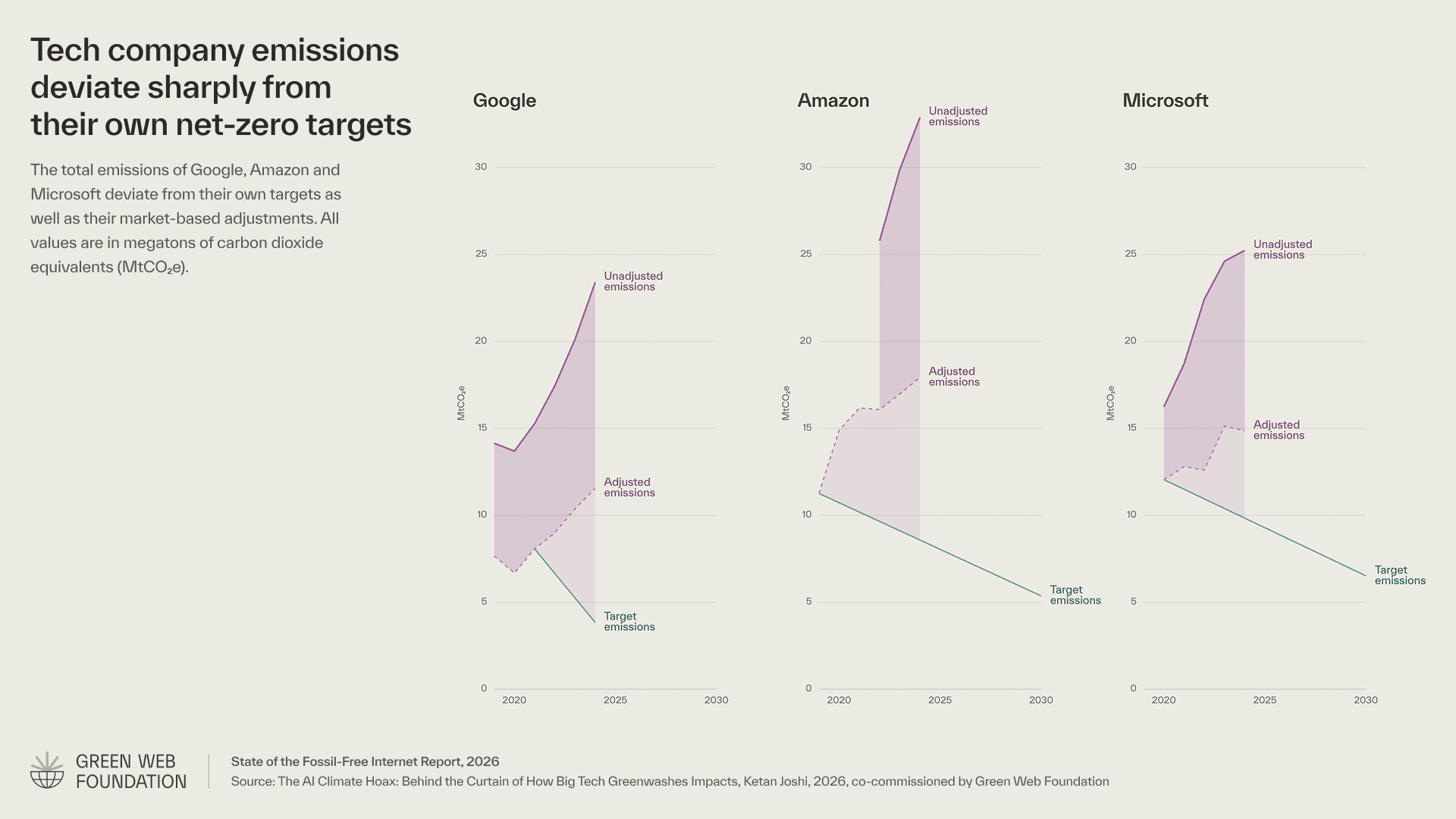
Google, Amazon, and Microsoft all disclose emissions in different ways—but they tend to hide the details of time and location. In headlines, they celebrate renewable energy purchases, while the raw figures for emissions are buried in reports. This obfuscation benefits their green image.
For instance, Microsoft says it matches its electricity use in Ireland to renewable energy 100%—and yet we see smokestacks from gas-powered generators big enough to provide power for 100,000 people every day peering up from between their buildings. Technically, Microsoft is correct. On an annual basis, they buy green energy to match what they use. In reality, they have also filed for (and received) a permit to run gas generators at the data centre for up to eight hours a day. Such facts, of course, do not make it into their sustainability marketing.
Neither Google, Amazon, nor Microsoft publicly disclose their energy use in a format that makes it easy to monitor or compare what types of energy they use in specific regions. This is a transparency challenge we, and many others, are working to solve as members of an industry association. Today, the reporting is scattershot, but we can at least begin to track progress on transparency using metrics and data collected (or not collected) through these joint efforts as well as our own independent research into what they disclose in public reports. To read more about the scope and limitations of our research, see our blog post.
How transparent are Google, Amazon, Microsoft about fossil fuels in their cloud services?
Source: Original research by the Green Web Foundation and the Cloud Region Metadata dataset (2024), Green Software Foundation [More on how we developed this chart]
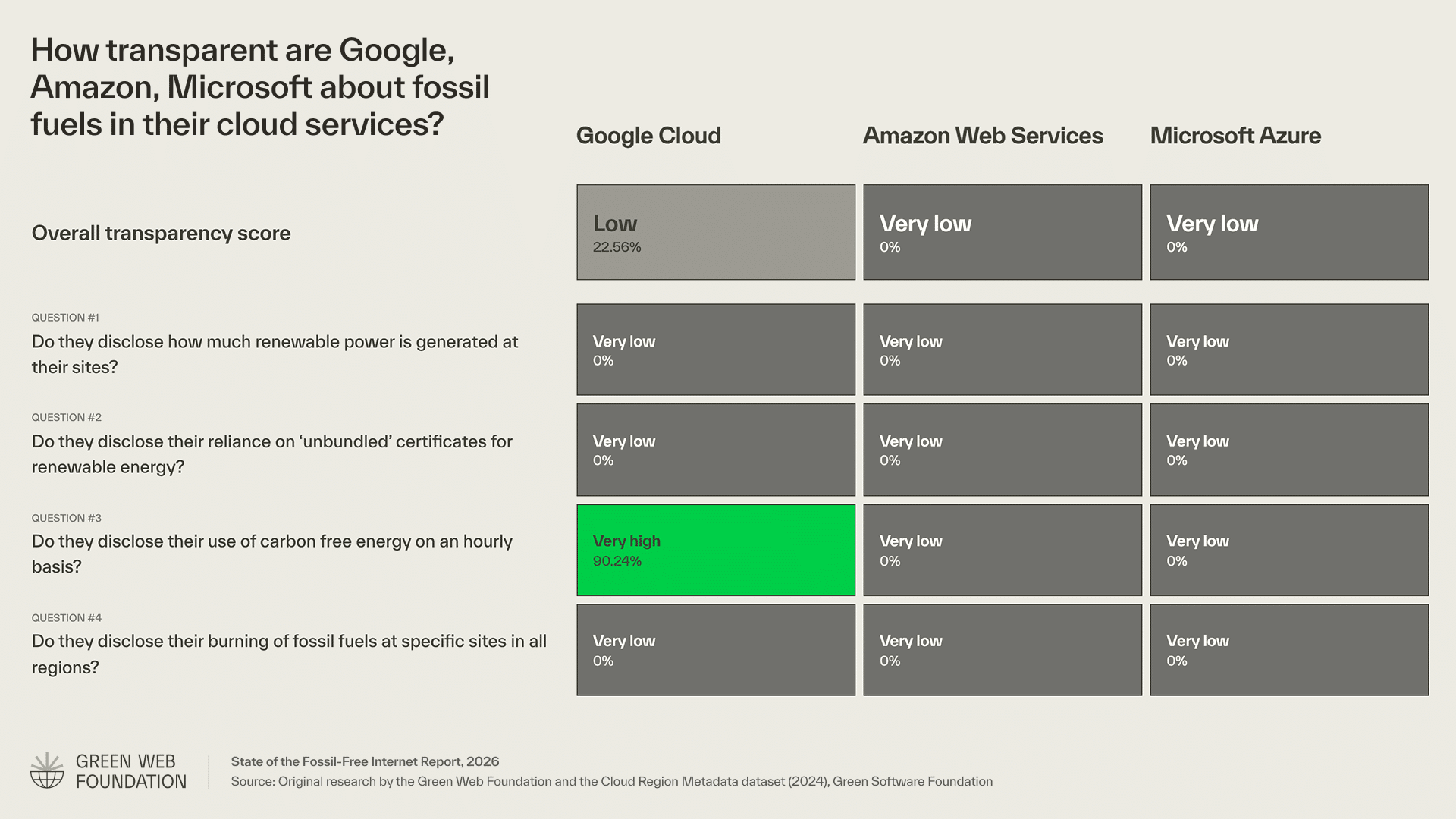
On the most important data points for energy use, Google Cloud shares slightly more information than Amazon Web Services and Microsoft Azure, but all three companies have huge gaps in their disclosures. We hope to keep tracking transparency improvements from year to year, but with only voluntary corporate sustainability reports, the information is likely to be inconsistent.
Meanwhile, we have seen companies go so far as claiming that their AI data centre expansions will help “solve” or “fix” climate change—a completely false narrative.
We have yet to see compelling evidence that building additional, new hyperscale data centres is worth the social and environmental trade-offs anywhere in the world. Neither a substantial number of jobs nor benefits to the local economy seem likely to materialise. What we do see is companies exercise selective disclosure to the public about their use of resources.
These companies owe the world accurate data about their real-time, location-based energy use and emissions. All claims about energy generation and use should be publicly accessible and independently verifiable. Decarbonisation goals should have concrete interim targets with accountability measures, and affected communities should be involved in decisions.
Pathways to a fossil-free internet

The problem
Too many dirty data centres controlled by unaccountable companies
Solution pathways
Pathway_01
Reduce the energy demand
Keep to planetary boundaries

Pathway_02
Green the energy
Cut ties with fossil fuels

Pathway_03
Democratise tech
More alternative ownership

A fossil-free internet is only possible if we work across all three.
When we speak of a fossil-free internet, it’s not as simple as plugging wind turbines into data centres. Increasing oversight and governance of major tech companies is a huge part of it, as is questioning elected officials who support data centre expansions. As a society, we should be contemplating our digital needs and the demands on finite resources. What do we want data centres for? How should this be weighed in relation to other needs? People should have a voice in what gets prioritised, say, between healthcare, housing, or hyperscale data centres.
We don’t live in a world with an infinite, harm-free electricity supply. We are headed in the direction of plentiful renewables, but we are not there yet—and it will not entail that we can use energy without limits. Cutting down on electricity use is crucial. This involves a variety of conscious choices of how to power data centres; how to decrease global dependency on the most polluting companies; as well as of how to develop websites and software sustainably.
It’s not just about efficiency, but sufficiency.
In the absence of transparent energy disclosures across all internet infrastructure, we can only approximate the true environmental impact. Our concerns extend far beyond energy use, though that’s the main focus of this report. For the community of people and organisations working on these complex and interrelated issues, a core focus is to pause all data centre expansions until there is more accurate and granular data available—locally and globally—and stronger measures in place to ensure that new data centres will not be powered by fossil fuels.
At Green Web Foundation, we work on a combination of technical tool development, policy and community action with allies around the world. You can join us in taking action. Below, we share examples of promising pathways to address the core challenges of this moment: The outrageous rise in energy demand from data centres; the challenge of greening the internet; and the dominance of the largest tech companies.
PATHWAY_01
Reduce the energy demand
The internet must operate within planetary boundaries. The justifications for expanding the capacity of data centres are questionable—certainly until local communities have more oversight and protections. We believe it’s time for an immediate global moratorium on the construction of new data centres to force robust considerations of the harms and to create public debate about what digital infrastructure society actually needs. Campaigns to halt data centres have succeeded in Chile, the Netherlands, Wisconsin, and Kentucky, among other places.
Tech
Use AI sparingly—or not at all
If you’re building with AI, you don’t need to default to the largest generative AI models. Traditional AI uses far, far less energy—but even with generative AI, the energy savings from using fine-tuned models can be huge. Try AI Energy Score on Hugging Face to help you identify efficient models. There are also transparent cloud services, like NeuralWatt, that charge fees according to energy use. Or the chat platform, GreenPT that shows real-time energy metrics. Above all, when AI isn’t truly needed, we need technologists to be bold and dare to refuse to use it.
Action
Get involved in the movement
There is nothing inevitable about the boom in data centres (or the hype to put AI in everything). We should all call for moratoria on new data centres, to collectively pause these questionable projects, so more democratic deliberation can happen. Worldwide, expansions are a contentious political issue that citizens are bringing to their local governments. Many communities are holding data centre operators accountable with investigative reporting and strategic litigation. Even industry insiders are sounding the alarm about the wrongs, and Microsoft’s CEO has openly wondered at what point social acceptance will expire.
Policy
Stop the greenwash
Tech companies are polluting public discourse (and the planet) with their vagueness about energy use and emissions. Greenwashing in marketing is illegal in the EU and US. We think tech companies are walking a fine line. Governments need to get wiser about the false narratives pushed by tech lobbyists—including about AI being good for climate change. All major tech companies should be publishing reports with structured data that follows standards that allow meaningful comparison, like those referenced in the EU’s Corporate Sustainability Reporting Directive (CSRD). Microsoft even offers products to support such disclosures by other companies.
PATHWAY_02
Green the energy
We’re calling on the digital sector to cut ties with fossil fuels and completely green their energy supply. Fossil-free energy is inherently fairer because no one owns the sun or the wind. While the economics of energy is changing, governments often prop up oil and gas and access to energy is weaponised between nations. The internet should be free of these dynamics.
Tech
Fight back against ‘weak’ green energy claims
Tech companies claim to use green energy—but they can’t be independently audited. As a technologist, you can tell suppliers that there are more meaningful ways to buy clean energy. There are also alternative standards for carbon accounting that are reality-based and consider when and where energy is produced. Looking for greener data centres? One example is Wind Cores, a German company that places data centres inside wind turbines. You can also look in the Green Web Check directory of green web hosts. This year, it will be updated with new verification criteria.
Action
Engage as a citizen
Tech will not solve the climate crisis, but engaged people can. Citizen assemblies are genuinely effective for local decision-making about your neighbourhood’s digital and climate future. Many big and small actions combined can have a huge impact. In the UK, construction of a hyperscale data centre was stopped on environmental grounds, following a legal challenge against a government deal after one person filed a public information request about tech firms lobbying for gas grid connections.
Policy
Support public infrastructure
Governments need to stay firm on their decarbonisation targets and call for transparent energy disclosures from data centres. There are examples of data centres that are fossil-free, and every one sets an example for others to follow. For many countries, reliance on imported fossil fuels is risky compared to green energy. Demands for energy sovereignty are converging with ideas for tech sovereignty, especially in relation to internet infrastructure owned by US companies. However, national or regional independence doesn’t automatically equate to public interest. Societies need to prioritise internet infrastructure that serves a public purpose.
PATHWAY_03
Democratise tech
The biggest tech companies use their dominance to act with impunity. They could be using green energy, but burn more fossil fuels instead. Public control and ownership of technology is barely on the radar, and this needs to be reversed. We need more alternative ownership models to rise to challenge corrosive power. We don’t need an AI arms race—we need to question the relentless demand for more AI and refuse energy-hungry technologies and infrastructures.
Tech
Strategise with others
Tech workers have demanded change inside and outside companies, but there are also gentler ways to push for change by learning and connecting with others through the ClimateAction.tech network. At work, allocate time and money to explore open and climate friendly approaches, and be more strategic about supply chains. Suggest the idea of a carbon budget alongside your monetary budget, so when you make technical choices you have to account for carbon emissions too. Join open source initiatives for green software. Use tools like CO2.js to measure emissions.
Action
Dream up alternatives
We can break free from a corporate technology mindset to imagine alternative tech futures that have equality and liberation at their core. Concepts like perma-computing, feminist servers, solar powered websites, and community owned data centres are concepts that reframe what innovation looks like and who it should serve. We can reimagine the electric grid as fully green and conceive of new ways to distribute energy between homes. We can seek global climate justice and take inspiration from the financial divestment movement that encourages withdrawing investments from fossil fuel companies.
Policy
Unlock greener options
We need policies that make it easier to compete on compute, storage, and networking capacity on fair terms—not just on price, but also on greenness. Crisis can drive change. For instance, political tensions with the US are leading to calls for cloud sovereignty in Europe, which is unlocking public funding for homegrown alternative services.There is also momentum around new data centre energy standards, and new procurement rules for cloud services that include environmental criteria. Advancing climate justice requires that more people affected by the environmental impact of AI be involved in actual decision-making about its development.
Support our work
We are hosting a free public briefing on the state of the fossil-free internet on Wednesday, May 27, 2026 (16:00 CET). Sign up here.
To stay informed about the fossil-free internet, sign up to the Green Web Foundation’s newsletter and join ClimateAction.Tech, an active community of tech workers instigating climate action in companies and organisations across many industries.
Using our tools, you can check if a website is running on green energy, find verified green hosting providers, build carbon metrics into your own digital services, or discover and use sustainability data via the web. Also, we recommend you read Branch Magazine.
About this report
Green Web Foundation is a non-profit organisation working towards a fossil-free internet by 2030. This report was supported by The Internet Society Foundation.
If you enjoyed or used this report, please let us know. All the links and references for this report can be viewed or downloaded from the Green Web Foundation’s public library on the open source platform, Zotero. There are more than 140 references organised in three folders corresponding to the main chapters of this report.
Lead editor: Solana Larsen
Program manager: Katrin Fritsch
Web development: Nick Lewis
Data visualisations: Christian Laesser
Design: Alice Apsey
Communications: Audrey Hingle
Reviewers: Ketan Joshi, Jill McArdle, Stefan Baack, Fershad Irani
Green Web Foundation co-leadership team: Chris Adams, Michelle Thorne, Hannah Smith
Suggested citation: Green Web Foundation. (2026). State of the Fossil-Free Internet 2026: The Dirty Data Centre Edition [Report].
Copyrights: CC-BY 4.0 International
This webpage was developed with sustainability and low carbon emissions in mind.